
Discover high-potential patents developed at IFW Dresden – validated technologies enriched with application insights and market perspectives. Whether you're from industry, research, or investment – this portfolio offers innovations ready for collaboration, licensing, or spin-off.
Validated Patents Database
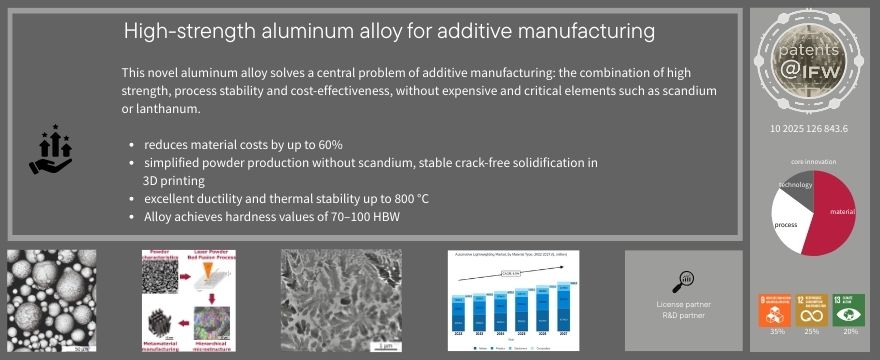
Additive manufacturing of aluminum is often limited by hot cracking, porosity, and dependency on expensive rare-earth elements such as scandium.This patent overcomes these barriers with a novel Al-Mg-Zr-Si-(Ca) alloy system, enabling reliable, crack-free additive manufacturing at significantly lower material cost.By replacing rare-earth elements with abundant silicon and calcium, the invention delivers high strength, excellent ductility, and superior processability, making aluminum additive manufacturing suitable for aerospace, automotive, and high-strength industrial components.

Udo Krause
IFW-Dresden
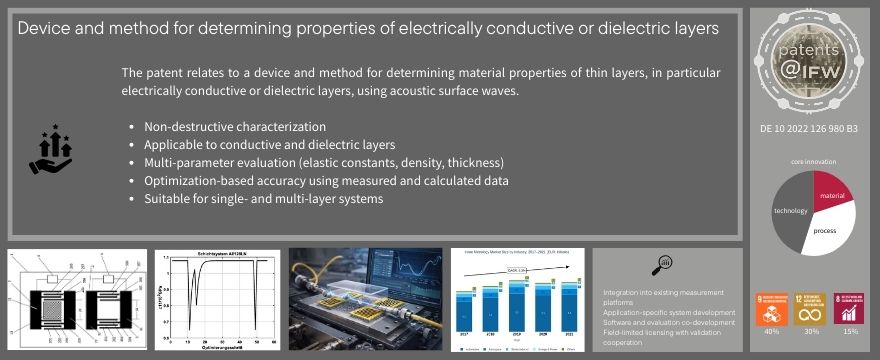
The patent relates to a device and method for determining material properties of thin layers, in particular electrically conductive or dielectric layers, using acoustic surface waves.The invention is based on an arrangement comprising:at least two interdigital transducers (IDTs) arranged on a solid-state substrate,a layer system applied to the substrate, anda measurement and optimization unit.Acoustic surface waves are generated and detected by the IDTs.The electrical reflection factor as a function of frequency is measured and compared with calculated values derived from an optimization algorithm.The method enables the determination of at least one material property of the layer system, including:elastic constants,density, and/orlayer thickness.A central feature of the invention is the use of an optimization software that iteratively varies the material parameters until a global or local minimum of an objective function is reached, based on the difference between measured and calculated reflection factors.
Udo Krause
IFW-Dresden
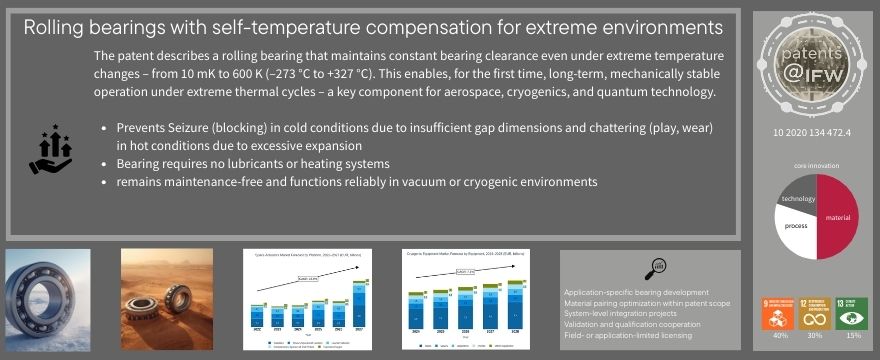
This patent portfolio addresses a core engineering challenge in mechanical and plant engineering:the reliable operation of rolling bearings under strongly varying and cryogenic temperature conditions.The protected invention enables an essentially constant bearing clearance over an extremely wide temperature range (from 10 mK to 600 K) by applying a targeted material pairing of inner and outer rings with different thermal expansion coefficients.The portfolio is positioned as a component- and engineering-driven innovation, targeting applications in which conventional rolling bearings fail due to jamming, excessive clearance, or accelerated wear.
Udo Krause
IFW-Dresden
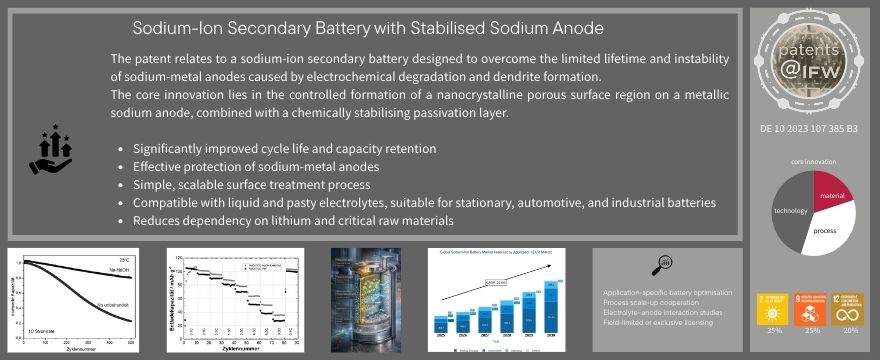
The patent relates to a sodium-ion secondary battery designed to overcome the limited lifetime and instability of sodium-metal anodes caused by electrochemical degradation and dendrite formation.The core innovation lies in the controlled formation of a nanocrystalline porous surface region on a metallic sodium anode, combined with a chemically stabilising passivation layer.Key technical features include:A metallic sodium anode,Formation of a nanocrystalline porous layer by oxidative hydrolysis in air,A passivation layer ionically bonded to the anode, containing at least one hydroxyl-group-containing compound (preferably NaOH),Optionally, the addition of a hydroxyl-group-containing additive to the electrolyte.This combination effectively protects the sodium anode from unwanted electrochemical reactions, suppresses dendrite growth, and significantly improves electrochemical stability, cycle life, and capacity retention of the sodium-ion battery.
Udo Krause
IFW-Dresden
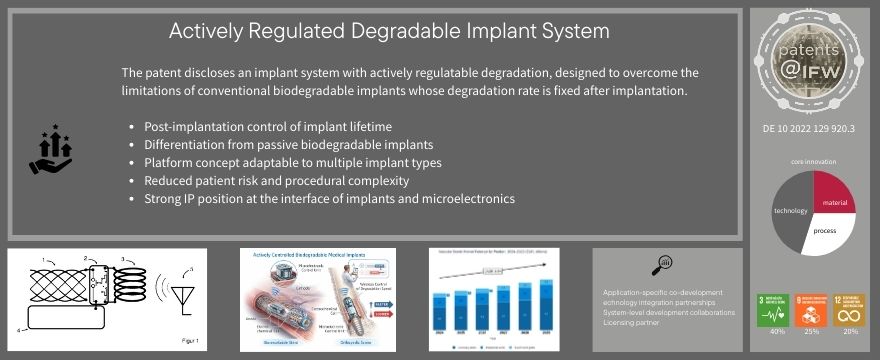
The patent discloses an implant system with actively regulatable degradation, designed to overcome the limitations of conventional biodegradable implants whose degradation rate is fixed after implantation.The invention combines:a metallic, biocompatible and biodegradable implant structure,a second metallic element with a different electrochemical potential,a mechanical contact element, andan integrated electronic circuit with a control unit.In the human or animal body, the implant structure and the metallic element form a galvanic cell using body fluid as electrolyte.By actively controlling the current density within this galvanic system, the degradation rate of the implant can be accelerated or inhibited after implantation.A key technical distinction from prior art is that the system:operates without a permanently implanted battery,can be wirelessly supplied with energy or control signals, andis designed so that all components are biocompatible and predominantly fully biodegradable.This enables post-implantation control of implant lifetime, matched to the individual healing process, without requiring a secondary surgical intervention.
Udo Krause
IFW-Dresden
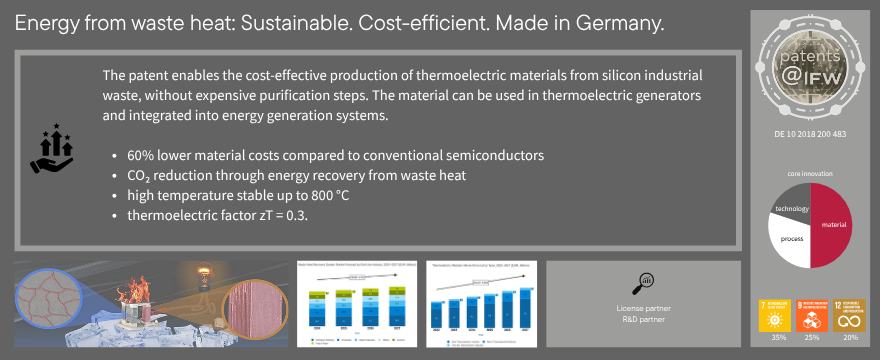
Energy from Waste Heat: Sustainable. Cost-Efficient. Made in Germany.A new, cost-effective thermoelectric material converts waste heat directly into electricity — and is produced from industrial silicon waste.
Udo Krause
IFW-Dresden

Interested and/or Questions?
HybridAI Connector by SupraTix
