The Challenge
Conventional biodegradable implants degrade at a fixed rate determined before implantation.
This does not account for:
individual healing times,
complications such as infection or immune response, or
changing clinical requirements after implantation.
Many existing electronic implant systems additionally rely on implanted batteries, requiring later removal.
The Patented Solution
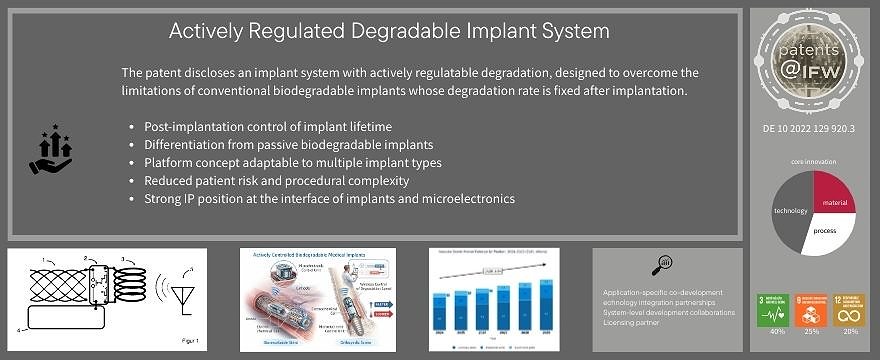
A fully biodegradable implant system with actively controllable degradation, based on:
a galvanic cell formed in vivo,
an integrated microelectronic control circuit, and
wireless energy and signal transfer.
The degradation rate can be actively accelerated or inhibited after implantation, without implanted batteries and without secondary surgery.
Key Technical Value
Post-implantation control of implant lifetime
Wireless regulation of degradation
Energy-autonomous operation via galvanic reactions
Compact, fully biodegradable system architecture
Applicability to vascular, orthopedic, and microrobotic implants
Value for License Partners
Differentiation from passive biodegradable implants
Platform concept adaptable to multiple implant types
Reduced patient risk and procedural complexity
Strong IP position at the interface of implants and microelectronics
Options for Joint Development & Cooperation
Application-specific co-development
Joint adaptation of the implant system to specific implant types (e.g. vascular support, bone fixation, microrobotic devices).Technology integration partnerships
Integration of the patented active degradation control concept into existing biodegradable implant platforms.System-level development collaborations
Co-development of fully integrated implant systems, combining biodegradable metals, electronics, and wireless control.Licensing with development milestones
Stepwise licensing linked to prototype development, validation, and clinical translation.Exclusive or field-limited licensing
Exclusive rights for defined medical indications or implant categories, based on the patent claims.
Licensing Options
Implant-system licensing
Application-specific licensing (e.g. stents, fixation, microrobots)
Co-development with medical device manufacturers
Target License Partners
Medical device manufacturers
Companies developing biodegradable vascular, orthopedic, or temporary implants seeking post-implantation control of implant lifetime.Implant system integrators
OEMs integrating electronic or electrochemical functionality into implantable medical systems.Specialized implant developers
Organizations working on temporary implants, resorbable stents, bone fixation devices, or biomedical microrobots.Microelectronics for medical applications providers
Companies experienced in biocompatible and biodegradable electronic components and wireless energy transfer for implants.